
An Interview with Carolyn Craig
Carolyn Craig is a Sydney-based artist and educator whose practice spans photography, print, and performance. She is the Head of Printmaking at the National Art School and an interdisciplinary artist whose work examines how power is manifested through biological relations and physical architectures.
As a founding director of SYRUP Contemporary and board member at Frontyard Projects, Craig is deeply embedded in Sydney's artist-run initiative community, where she continues to push the boundaries of what printmaking can be. Her work has been recognized with the 2024 Hornsby Art Prize Printmaking Prize and is held in collections including the National Gallery of Australia and the National Library. In this interview, Craig reflects on her journey from apprentice offset printer to leading educator, the embodied safety she found in the print room, and how printmaking's historical entanglement with power makes it the perfect medium for subversive actions.
Against Precarity, presented as part of Pretty Good at Tiles, Lewisham, 2022. Laser etched Perspex and wood frame, 190 x 60 x 160cm. (Damian Dillon works in background on wall)
What initially drew you to printmaking, and how has your relationship with the medium evolved throughout your career?
My attraction to print goes a long way back, but not in the visual art sense. I was a paper girl when I was seven, running out into peak hour traffic to sell the late edition of the now-defunct Sun paper. I also had some broken photocopiers that I played with as my main toys as a child.
So, it seems, looking back now, that I would grow up and be attracted to print. And I was, although I started with a very working-class idea of print as an apprentice offset printer, and hated it. So, I walked away from print for 20 years until an injury took me to art school.
I thought I would be a painter because I still held these social perceptions that real artists painted and working-class people made offset prints. But when I walked into the print room I felt safe. I didn't feel safe in the painting studios. Embodied safety is a huge reason I ended up in the space of print. That sense of safety also comes from the mechanisms of making itself. Print engages collaboration via machine (in the cyborg sense) but also at the level of material exchange—the shared nature of the studio. I feel fewer threatening egos in the space, although we are not exempt from those either. I was also attracted to print's connection to the business side of cultural manufacture—that is, its central mechanisms of power. That copy machine in my bedroom represented the tools of the grown-ups—of power, of rules, of enterprise. Playing with it gave me an affectual sense of that arena, but I could also be subversive. Nothing has changed really.
Proximal Noise: Principles and actions against Anoxia, etchings from performance documentation, approx. 110 x 104cm, 2021
Your practice spans photography, print, and performance. How do these disciplines intersect in your work, and what role does the body play as both subject and tool?
The role of print, photography and performance all converge within the same embodied condition of subject formation via the image (for me). How do images of self/other reside in each of us to create an agreed-to cultural metaphor of being? How do the images in flux around me coerce my acts and desires? And how does a subject navigate the limits of input control? My practice engages in these questions to infiltrate new representational forms of my own representational state—via diffracted, misaligned acts of re-presentation.
In my late teens I was filmed outside the Love Machine (an iconic brothel in Sydney’s Kings Cross neighborhood) for a cheap current affairs show article on the dangers of AIDS. A few months later a family member sexually assaulted me because I was a 'whore'. That news bite—it does real things to real bodies—and that image and its repercussions continue to haunt me.
Temporal Persistence 2: affective detritus (still image of video work), Custom perspex tank size here , Algae (Dunaliella strain grown from live sample), Water, Air Pump, Tube, Performance video on loop with cloud sequence, Projector, USB, Cables, Plywood Plinths, 2025
Installation image Sites of Infection, Plywood frame, Glass Jars, Algae Strains (Nannochloropsis, Dunaliella, Spiralina), Air Pumps, UV lights, Power cords, Micro USBs, Speakers, Data noise, Internet recordings, oxygen, Water. Dimensions variable approx. 190 x 80 x 120cm, 2025
As Head of Printmaking at the National Art School, how do you approach teaching printmaking to a new generation of artists?
That's a big question that I pose myself constantly, and I suppose that's how I approach teaching—as an ongoing query. I frame our lecture series around how to locate a methodology of print theory for the 21st century. We start with what print has been and then consider what it might become. At the same time as this conceptual frame is introduced in lectures, students are given the best and most fundamental technical training. We don't over-labour its pedantic histories but pursue the excellence that underpins those mechanics. Once they have a fundamental toolbelt we introduce conceptually driven workshops that are framed to challenge the linear narrative that underwrites the more illustrative history of print as an adjacent image technology.
I also have the most amazing team of teaching staff who are carefully paired to foster diversity and challenge.
How do you balance encouraging technical mastery with pushing students toward more experimental, expanded approaches to print?
I think I may have answered a bit of this above. We don't start with "anything goes"—we give students the technical means to drive their own futures and connect this to the idea of print as cultural production itself. Each student is then provoked to self-define what a matrix is for them and what modes of remediation or re/production inform their needs and goals. This allows for very traditional outcomes as well as expanded investigations into what underpins the image and its circulations in our time.
Installation image of Grazing on Flesh presented at THE HOLD, Brisbane, 2019
You're a founding director of SYRUP Contemporary and a board member at Frontyard Projects. How does collaborative work inform your individual approach to printmaking? What role do you see artist-run spaces playing in supporting experimental printmaking practices?
Printmakers understand collaboration. We collaborate with the machines and objects in the studio and with the bodies and breath of all its users. Together we form an amorphous machine of production. This material and embodied exchange underwrites my practice. What someone says to me as they walk past, the conversations between the students and staff on a Saturday as we share the space—this informs the critical momentum of my work. I think this is also what draws me to Artis-Run Initiatives (ARIs).
ARIs feed the cultural landscape with risk, care, ambition and generosity, and they compost the next generation of aesthetics. They feed culture and they also feed me.
The economics of space/real estate means that the ARI system is becoming even more critical for risk-taking. If a young artist must pay to rent a space early on, risks are unlikely. Recent print graduates are also on fire—they are shaping discourse far beyond print and its specificities to engage more with visual replication and its terrifying implications into the future.
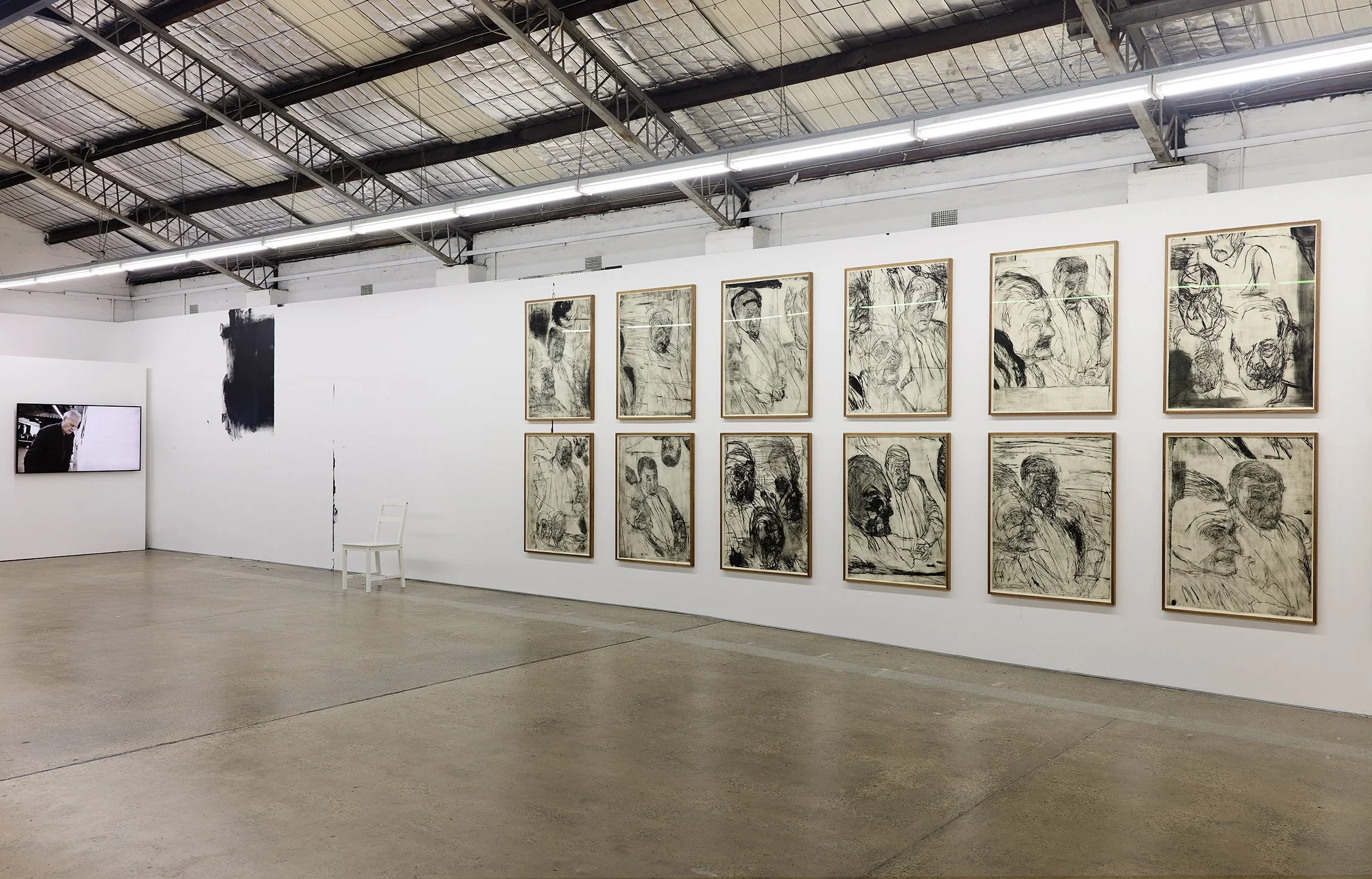
Mike Parr Human Animals installation presented as part of Turning a Blind Eye at SYRUP Contemporary, 2025.
12 drypoint etchings, wall residue from performance , performance chair and photographic documentation on loop
Roadside Remains #3 (Left Behind in Lithgow) Charcoal dust from Bushfires screenprinted through mesh 90 x 120cm 2020
You've created works responding to environmental and political situations. How do you view printmaking's relationship to site-specificity and environmental engagement?
Print has a deep legacy to colonisation and power—Francis Bacon stated that three things defined his era of expansion: gunpowder, navigation and the printing press.
As a material domain so implicated in systems of legislation and control, it is ripe for subversive activation. Print as copy-paste matrix is the dispersing material of our time, and to me, the most direct means to consider its relational acts—both to the environment and the site (place) which is bound by text.
Your work is held in collections including the National Gallery of Australia and National Library. How do you view the relationship between your experimental practice and institutional recognition?
I think it's just an accident that my work is in significant collections, but I also don't see a difference between a static image and a tank of algae with a projection. They both construct the idea and inform its iterations. But I do hope that the works they bought hold an echo of the expanded repercussions they invoke.
Drawn with dust ; soiled subjects and affectual dirt, chalk on blackboard, dust, video 2022
Remediation my mothers broom, chalk on blackboard with performance video 2022 4.53
Who are some contemporary artists (printmakers or otherwise) that influence your work?
Oscar Muñoz, Camille Henrot and Chris Marker (La Jetée), and Lynne Allen who has been a long-term mentor and friend.
But it is the artists in my own ecology that help to ferment ideas—people such as Bianca Hester, Joan Ross, Todd McMillan, Rebecca Beardmore, Alexandra Peters and my partner Damian Dillon who calls out bad work immediately.
Installation image of Who Gets the Rose, presented at Photo Access, Canberra 2024. Welded Steel frames, UV prints on Glass, 4K Videos on loop, dimensions approx. 3m x 5 m x 2m, 2023.
Where do you see the future of printmaking education heading, particularly in terms of expanded practice?
That's a hard one. I see traditional skills holding a critical groundwork—especially as its mechanisms of touch reorient bodies into haptic discovery. Beyond that initial training I would see more integrated learning modes—where the intersection of material domains generates intersectional knowledge. Every college is trying to do this, but I think it needs less to work. That is, I think print should stick to material extensions that reflect the conceptual relations of its parameters—copy, trace, mediation, glitch, contact, impact, transfer and release, inversion and reversal. These process terms will shape future interdisciplinary acts—at least I think they should.
I also don't think expanded print is everything—sometimes I just want a luscious aquatint and lines that trace the movements of a body in such control that I can feel where they have been.
Kentridge is pretty damn fine at that.
How do you see printmaking's role evolving in contemporary discourse around power, representation, and social change?
Print is embedded in the ways power is constructed, from printing legislation to the Bible to pornography—its distributions construct our identity. I also think about the witch hunts and the ways the posters of the time were used to generate the visual trope of the hag/witch and target women of difference—often midwives.
For more about Carolyn’s work:
Each featured post in the Womxn in Expanded Print series is accompanied by a donation to the cause of each artist’s choosing in their name. Carolyn has chosen Médecins Sans Frontières.
The Print Club Journal
Never miss a story from the studio
Printshop tours, artist interviews and guidance for building your collection — delivered to your inbox. Join our mailing list for new Journal articles and the occasional note from the studio.
Join our mailing list