
What the Hand Carries | The Ceramics of Donna DeSoto
Some makers spend a lifetime deepening a single craft. Others carry one discipline into another and find that the first was preparation all along. Donna DeSoto works in the second way. She came to ceramics as a textile and fashion designer who had already spent years thinking in the logic of surface design, and that history remains legible in everything she throws.
A view through to one of the two dining areas at Café Frieda.
Before the clay there was fabric. DeSoto designed textiles and clothing in New York and ran her own handbag company, building a practice around surface and pattern long before a wheel entered the picture. She is, by her own account, a designer at heart whatever the material in front of her. The throughline is not a medium but a way of seeing: how a repeat holds a plane, how shadow and shape become a kind of background noise the eye reads as texture.
The introduction to clay came early but obliquely. As a student at the Rhode Island School of Design, she worked on a series of silkscreen-printed ceramic tiles for a furniture project. It was a glancing encounter with a medium she would not take up in earnest for years, but it planted something. What she took from RISD was less a single technique than a set of habits: to consider context, to notice pattern and derivation, to study design history, and to step back and look at everything. She still cites the simplest of these lessons, that you get good at what you practice.
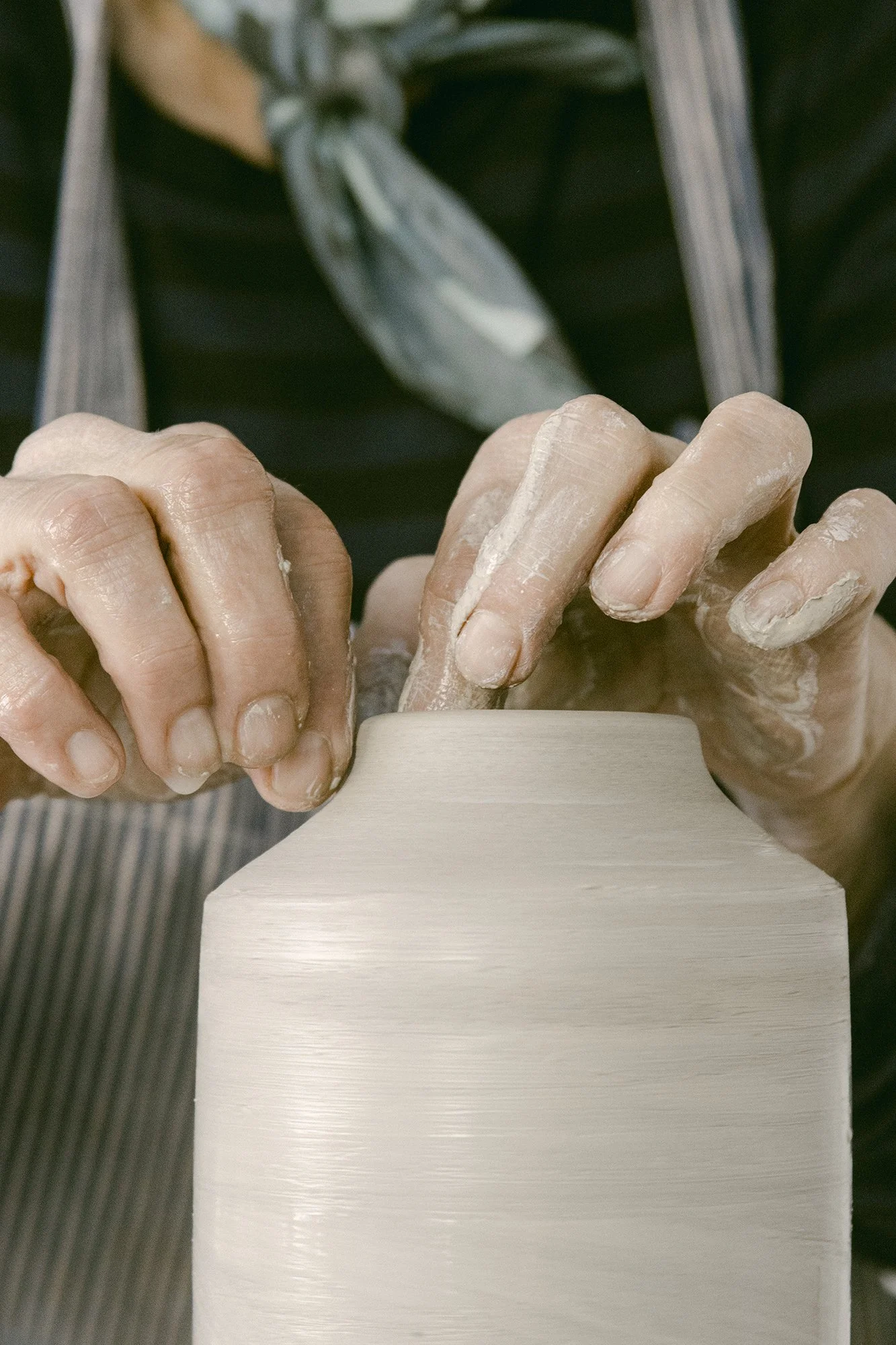
DeSoto at work in her LA ceramics studio
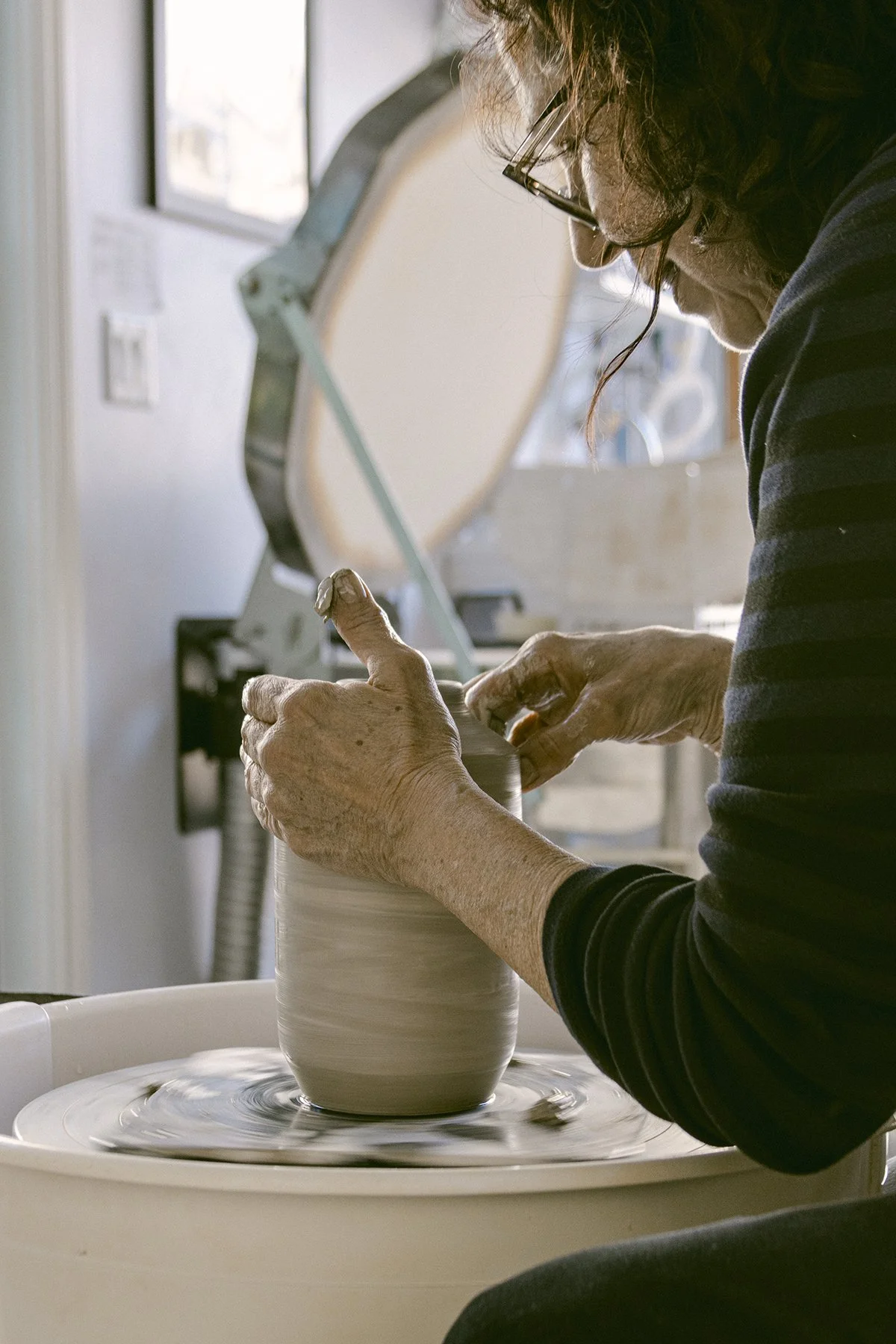
In 2013 she left New York for Los Angeles, drawn by family and by the chance to make ceramics her focus rather than her hobby. What had been an evening practice became the work. She makes functional wheel-thrown and hand-built pottery in porcelain and stoneware: vessels, serving ware, objects meant to be used. She calls them livingware, pieces designed to enter daily life and also to hold their own as objects in a room. The act she returns to is the quiet one, centering a ball of clay on the wheel and drawing it up into form. The transformation from raw material to useful object is the part she never tires of.
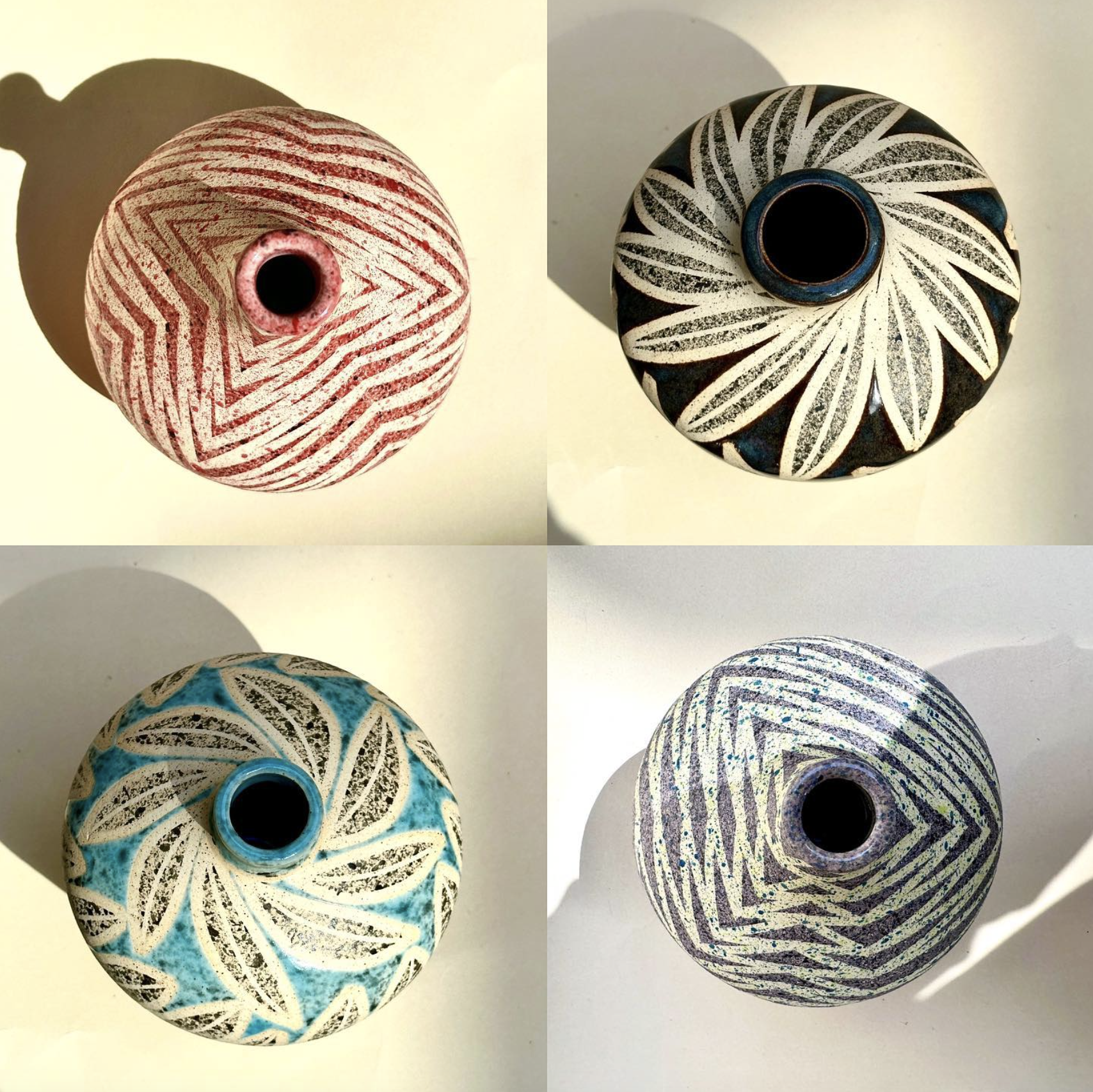
Four patterned vessels produced by DeSoto, image courtesy of her Instagram.
What makes the work unmistakably hers is the surface. DeSoto builds intricate geometric patterns and transfers them onto her vessels through a careful process of masking and airbrush, a method that owes everything to her years in textile and surface design. The pieces are developed as families, flexible groupings in related colour-ways that speak to one another rather than standing alone. Lately she has been working with weave patterns and basketry, which she describes as coming full circle: the textile vocabulary she began with, returned to her through clay.
It is this quality, a surface that thinks like a textile, that brought her into the print series she made with Print Club.
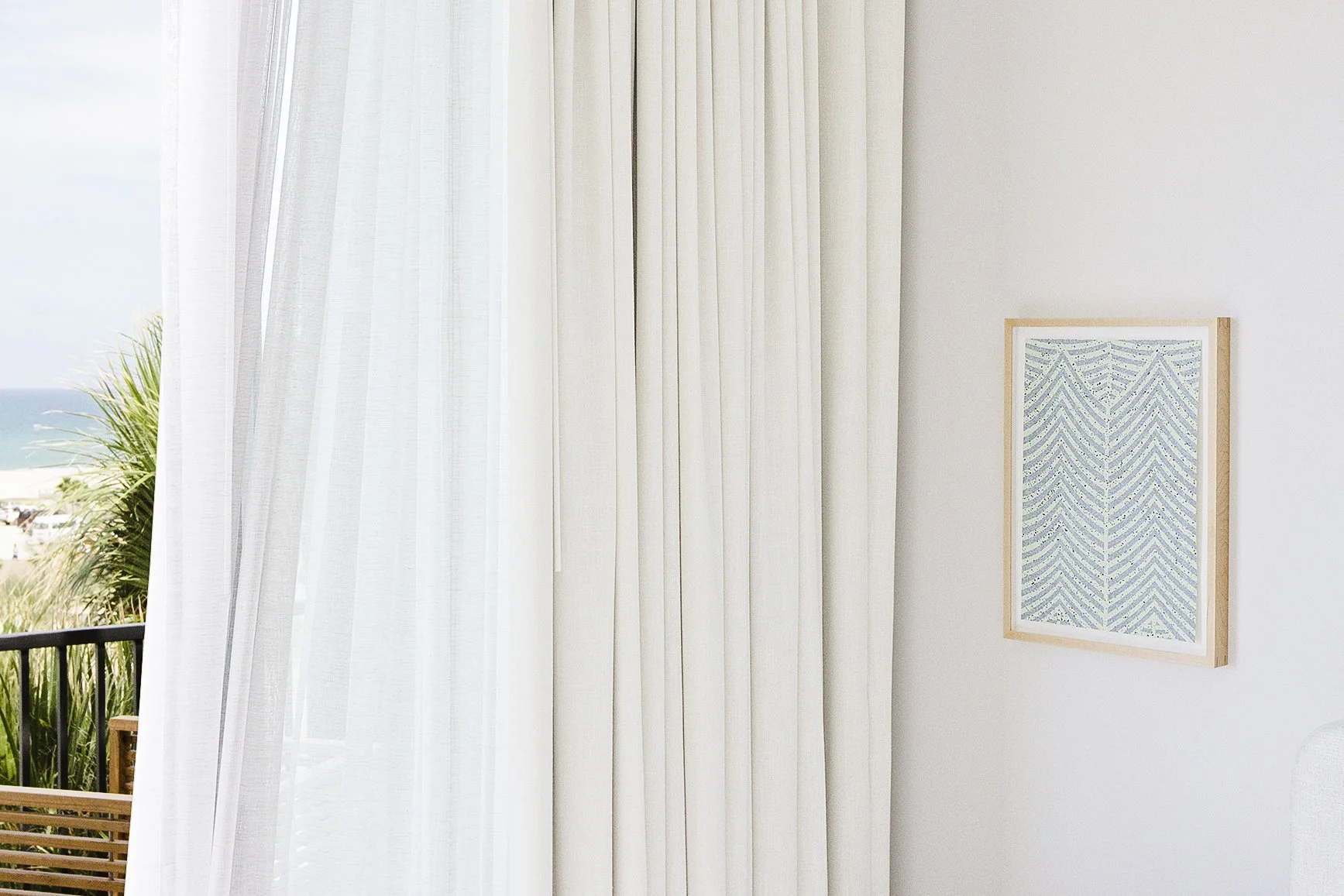
Green Surface installed in a private residence.
The edition project began with a question about how people actually live with objects. For a group of homes at Costa Palmas, on the coast of Baja California, Print Club developed a body of work drawn from research into the Mexican Functionalists, the architects and designers of the 1930s, among them Juan O'Gorman and Juan Legarreta. The Functionalists worked by an economy of materials. They refused to disguise brick, wood and stone behind ornament and made a feature instead of raw, unadorned surface. Their buildings were conceived in sympathy with their sites, and they kept decorative art off the walls in favour of everyday useful things: cups, vessels, serving bowls.
That last principle set the brief. If the Functionalists prized the useful object over the decorative one, then the artwork for these homes would take the useful object as its starting point. Clay became the touchstone across the whole collection, a material of earth and water suited to a coastal place. Print Club invited a small group of ceramicists to collaborate: Donna DeSoto and Zoe Dering in California, Natan Moss in New Mexico, and Eugenia ‘Uxii’ Diaz in Mérida. From their forms and surface techniques, a series of eighteen limited edition silkscreen prints was produced, each drawn from the mark-making and built forms of its maker.
A detail of DeSoto’s Blue/Cream Surface print
There is a neat recursion in this project. DeSoto's process already translates one medium into another, carrying textile pattern onto a ceramic surface. The Print Club edition translates it once more, lifting it from the glazed vessel into silkscreen, a printmaker's surface. Her trio of prints takes the graphic quality of her taped designs as well as the speckled nature of her airbrush technique and renders them as flat images that still carry the memory of curved forms. Her richly developed patterns survive every translation.
All three prints by Donna DeSoto are available in a limited edition of 20, individually numbered and embossed with our printers chop.
Explore Donna’s Print Edition
Reflected Surface installed in a private residence.
The Print Club Journal
Never miss a story from the studio
Printshop tours, artist interviews and guidance for building your collection — delivered to your inbox. Join our mailing list for new Journal articles and the occasional note from the studio.
Join our mailing list